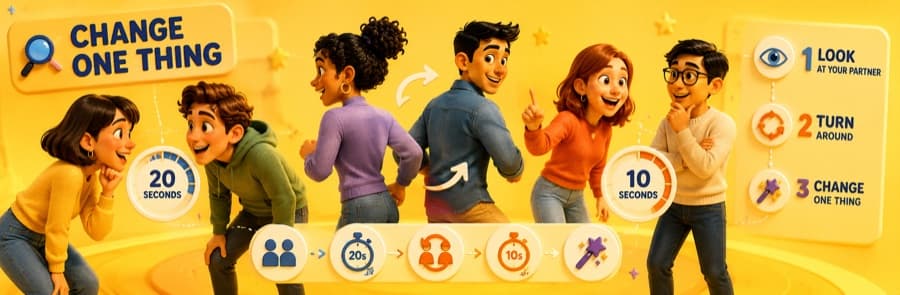
Change One Thing

Look at your partner. Now turn around and change something.
Pairs study each other for twenty seconds, turn back to back, and each changes one visible thing. Turning round, they have ten seconds to spot it. The second round asks for two changes and the difference in difficulty between one and two is much larger than anyone expects.
Find a partner and look at them properly for twenty seconds. Then you'll both turn away and change one thing about yourself that someone could see. Nothing you'd rather not change β a sleeve or a watch is plenty.
You have no floor space and a room that has stopped noticing anything β a fixed-seating room, a long table, or a lecture theatre.
Props: None
Run this whenβ¦
If none of these is your room, pick another.A quiet pairs activity that needs no space
Before a session on attention or noticing
A room with fixed seating and no floor
How to run it
Written to be glanced at mid-room, not memorised.
- Pairs, facing each other.
- "Twenty seconds. Look at your partner properly."
- "Now turn back to back."
- Each person changes one visible thing: roll a sleeve, move a watch to the other wrist, change how they are standing, swap which hand holds something.
- Turn back round. Ten seconds to spot it.
- Reveal.
- Round two: two changes each, twenty seconds to spot them.
- Swap partners for a third round if it is landing.
Running it well
Only the host sees these. Participants never do.
- Give examples of changes before the first round. Without them, half the room stands there having thought of nothing.
- Say clearly that nothing needs removing beyond a watch or a jacket. It takes two seconds and heads off the obvious problem.
- Two changes is where it gets good, because people find one and stop looking.
- Odd number: join in yourself rather than making a three.
Watch out for
Space, safety and the traps worth knowing before you start.
- Nothing personal, nothing anyone would rather not adjust, nothing that involves clothing beyond a sleeve or a jacket. Say it up front, lightly, once.
- Works in any space, including seated in rows facing each other.
Already seated
Nobody has to stand for this one.
No change needed β it already works entirely seated.
On a video call
The cards work as they are. This is what changes about how you call it.
Better on a call, and no breakouts needed. Everybody looks at the gallery, then all cameras go off at once, everyone changes something, and all cameras come back on together. The whole room plays against the whole room rather than against one partner β and thirty faces changing at once is a far better reveal than a pair turning round.
If you want a debrief
Optional. Plenty of energisers are better left as the thing that woke the room up.
- What did you notice about your partner that you had never noticed before?
- Why was the second change so much harder to find than the first?
Run it yourself
Free for thirty days, no card. Put it on the projector and step through it β nobody in the room needs a phone.
Start freeAlready have an account? Sign in
- Where
- Remote or in person
- Props
- None
- Big screen
- Required
- Teams
- Individual only