← Make them Think

Don't Answer That

Don't Answer That
Remote or in person

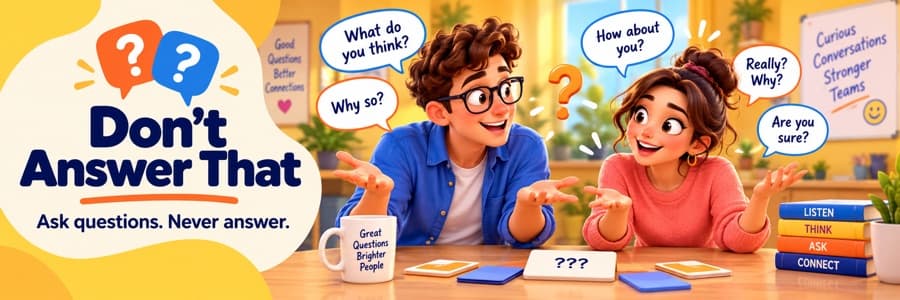
Two people ask each other questions. Neither may ever answer one.

Pairs hold a conversation made entirely of questions β€” every line has to be a question, and answering loses. It sounds impossible and is oddly easy for about twenty seconds, then collapses, and the collapse is very funny to watch across a room.

Say this to the room

Find a partner. You're having a conversation where every single thing either of you says has to be a question. No answers, no statements. If you answer, you've lost that round and we start again.

CommunicationLaughterFocusMental Agility
Use this when

Before anything about questioning, curiosity or sales conversations, and any time a room needs to talk in pairs.

Props: None

Run this when…

If none of these is your room, pick another.
  1. Before a session on questioning or discovery

  2. A sales or coaching skills workshop

  3. A group who need to talk to one person first

How to run it

Written to be glanced at mid-room, not memorised.

  1. Pairs, facing each other, sitting or standing.
  2. Every single line must be a question. Statements and answers both lose.
  3. The screen shows a worked exchange that loses β€” read it out once.
  4. Ninety seconds. Pairs restart themselves whenever one of them loses.
  5. Ask who managed the longest, then have that pair do it in front of the room.
  6. Ask what made it hard β€” the answer is usually that questions want answering.

Running it well

Only the host sees these. Participants never do.

  • The worked example on screen does the demonstrating. Read it out once and the room understands the rule instantly.
  • Let pairs restart themselves rather than policing it. Half the fun is the argument about whether that counted as a question.
  • Putting the best pair in front of the room at the end is worth it β€” everybody else has now played and appreciates how hard it is.

Watch out for

Space, safety and the traps worth knowing before you start.

  • Nobody moves, so it works in any seating.
  • Pairs get loud. Agree a stop signal before you start.
  • An odd number makes a three, which is harder and works fine β€” the questions go round.

Already seated

Nobody has to stand for this one.

Already seated β€” turn to whoever is beside you.

On a video call

The cards work as they are. This is what changes about how you call it.

A fishbowl. Spotlight two people, everyone else watches with microphones off, and the room counts the exchanges out loud in the chat. Breakouts would hide both the cards and the pair, and being watched is what makes people lose it β€” which is the entertaining part.

Run it yourself

Free for thirty days, no card. Put it on the projector and step through it β€” nobody in the room needs a phone.

Start free

Already have an account? Sign in

At a glance
4–100people
5–8minutes
Energymedium
Where
Remote or in person
Props
None
Big screen
Required
Teams
Individual only
What it builds
communication