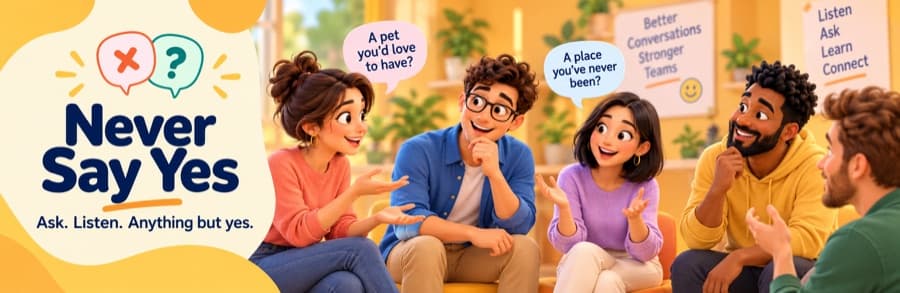
Never Say Yes

Answer every question. Never say yes, no, or your own name.
People pair up and interview each other, and the answers can never contain yes, no, or their own name. It sounds trivial until somebody asks you a direct question and you watch your own mouth try to say yes. It is the best two minutes of listening practice there is, and it is genuinely funny to watch.
Find a partner. You're going to ask each other questions. You can answer anything, but you can never say yes, no, or your own name. If you slip, swap over and the other person is answering. Go for it.
Before anything about listening, questioning or thinking on your feet β and any time a room needs to talk in pairs rather than to you.
Props: None
Run this whenβ¦
If none of these is your room, pick another.Before a session on questioning or active listening
An interviewing or sales skills workshop
Any group who need to talk to one other person first
How to run it
Written to be glanced at mid-room, not memorised.
- Pairs, sitting or standing, facing each other.
- One asks, one answers. The answerer can never say yes, no, or their own name.
- Anything else is allowed β including whole sentences that dodge the question.
- When the answerer slips, they swap roles immediately.
- Ninety seconds is plenty. It is exhausting.
- Ask who never slipped, and ask them how they were doing it β that is the useful bit.
Running it well
Only the host sees these. Participants never do.
- Demonstrate one exchange yourself and get caught on purpose. The room understands it instantly and nobody has to read a rule.
- The good question is a boring direct one β "is this your first time here?" People slip on those far more than on clever ones.
- The debrief is one question: what were you doing instead of answering? That is deflection, and everybody has just done it on purpose.
Watch out for
Space, safety and the traps worth knowing before you start.
- Pairs talk over each other and the room gets loud fast. Agree a stop signal before you start rather than shouting over it.
- An odd number makes a three: one answers, two ask, which is harder and funnier.
Already seated
Nobody has to stand for this one.
It is already seated. Turn to whoever is beside you and nothing about it changes.
On a video call
The cards work as they are. This is what changes about how you call it.
A fishbowl rather than breakouts, because a pair in a breakout can see neither the cards nor you. Spotlight two people and everybody else watches with their microphone off. The audience is what makes it hard, which is why this version is funnier than the in-person one. Swap the pair every ninety seconds so several people get a turn.
Run it yourself
Free for thirty days, no card. Put it on the projector and step through it β nobody in the room needs a phone.
Start freeAlready have an account? Sign in
- Where
- Remote or in person
- Props
- None
- Big screen
- Required
- Teams
- Individual only