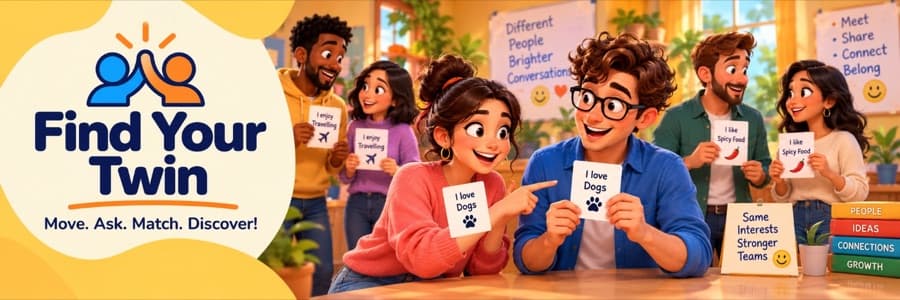
Find Your Twin

Somebody in this room matches you. Yes-or-no questions only. Find them.
Everybody moves around asking each other yes-or-no questions until they find somebody who matches them β a pet, a country, a taste for chilli. Nothing is handed out and nothing is decided in advance, so what people ask reveals as much as what they answer. The pair then finds three things they share, and the most surprising one goes to the room.
Move around and ask anyone a question they can answer yes or no β do you have a pet, have you been outside the country, do you like spicy food. You're looking for somebody who answers like you. Sixty seconds. When you find them, stand together with your hands up.
A room that has not mixed needs to mix fast, and you want the pairs made by the activity rather than by the seating plan.
Props: None
Run this whenβ¦
If none of these is your room, pick another.A group who arrived in cliques and sat in them
Pairing people up for whatever comes next
Straight after lunch, when the room needs volume
How to run it
Written to be glanced at mid-room, not memorised.
- Nothing to prepare and nothing to hand out. Everyone already has what they need.
- "Somewhere in this room is somebody who answers questions the way you do. Find them."
- One rule: only questions that can be answered yes or no. Give three examples off the screen so nobody stalls β do you have a pet, have you been outside the country, do you like spicy food.
- Sixty seconds, and mean it. The clock is what gets people talking to strangers.
- Pairs stand together with their hands up, so you can see at a glance who is done.
- Applaud the first pair out loud. It sets the pace for everyone still moving.
- Once most of the room has paired: "Now find three things you actually have in common. Thirty seconds."
- Take the most surprising match from four or five pairs, out loud, then run one more round with a different person.
Running it well
Only the host sees these. Participants never do.
- There is no correct twin, which is the point β a pair is whoever two people decide is close enough. Nobody can be left unmatched by the design.
- If a pair claims each other in ten seconds, send them back out for a harder match. The questions get better under pressure.
- The three-things-in-common half is where the connection is actually made. The hunt is just what gets them talking to somebody they did not choose.
- Cut the hunt while two or three people are still looking. Waiting for the last person costs the room its energy and costs that person their dignity.
Watch out for
Space, safety and the traps worth knowing before you start.
- People move fast and look at each other rather than where they are going, so clear bags and chairs first.
- Anyone who would rather not move can stay put and let the room come to them β the questions work either way.
- Keep the example questions light. Pets, food, travel. Anything touching on appearance, background or family is not a game.
Seated version
βEverybody stand upβ is not a neutral instruction. Offer this alongside, not instead.
Questions are called across the room from seats and answered with a thumbs up or down; the facilitator points to who asks next so it does not become a shouting match.
If you want a debrief
Optional. Plenty of energisers are better left as the thing that woke the room up.
- What question got you there fastest?
- What did you have in common that you would never have guessed?
Run it yourself
Free for thirty days, no card. Put it on the projector and step through it β nobody in the room needs a phone.
Start freeAlready have an account? Sign in
- Where
- Needs a room
- Props
- None
- Big screen
- Required
- Teams
- Individual only